
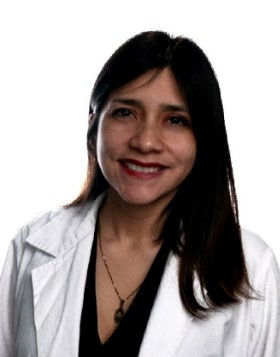
Dr. Berenice Urtecho:
Dr. Berenice Urtecho is a clinical fellow in Thoracic Medical Oncology at Princess Margaret Cancer Centre, University Health Network. She completed her original medical training in Peru, followed by medical oncology training in Spain, and came to Canada to further develop her expertise in lung cancer care, translational research, and precision oncology. Her work focuses on improving outcomes for patients with thoracic malignancies through biomarker-driven research, liquid biopsy, real-world data, and innovative approaches that integrate clinical, molecular, imaging, and digital pathology information. She is particularly interested in making research more clinically meaningful and in advancing precision oncology toward more personalized and equitable care.
1. Which projects are you working on?
I am currently involved in several projects in thoracic oncology, most of them focused on precision medicine and on improving how we personalize care for patients with lung cancer. One of my main projects is RELIANCE, which combines radiomics and circulating tumor DNA to better predict recurrence in early-stage lung cancer. I am also involved in LEADER, a project exploring how artificial intelligence and digital pathology can help identify important biomarkers such as EGFR, ALK, and ROS1. In parallel, I work on real-world data projects, including research on prior primary malignancies in patients with molecularly defined lung cancer and on small cell lung cancer transformation, with the goal of better understanding patient characteristics, treatment patterns, and outcomes in routine clinical practice. I am also very interested in liquid biopsy and resistance mechanisms in oncogene-driven lung cancer. What I value most about these projects is that they remain closely connected to real clinical questions and have the potential to translate into more precise and accessible care.
2. Why did you come to Canada to do your fellowship?
I came to Canada because I wanted to train in an environment where excellent clinical care and meaningful research are closely integrated. Princess Margaret has a remarkable culture of collaboration, innovation, and academic excellence in thoracic oncology. For me, this fellowship represented an opportunity not only to deepen my clinical training in lung cancer, but also to grow as a researcher and as a future academic oncologist in a setting that encourages curiosity, mentorship, and impactful work.
3. Why did you choose to work in this lab?
I chose this lab because the research is strongly grounded in clinically relevant questions. I was particularly drawn to a group where research is consistently linked to patient care and where there is a clear commitment to improving outcomes through thoughtful, collaborative work. I also saw it as an environment where I could continue developing both scientifically and professionally, supported by generous mentorship and a strong collaborative spirit.
4. What attracted you to oncology?
What attracted me to oncology was the combination of science, complexity, and human connection. It is a field that is intellectually demanding and continuously evolving, while also offering the privilege of supporting patients during some of the most important moments in their lives. I was especially drawn to lung cancer because it is an area where research is rapidly changing practice, and where advances in biomarkers and targeted therapies can have a direct and meaningful impact on patient outcomes.
5. What are you planning on doing in the future?
In the future, I hope to build an academic career in thoracic oncology that combines patient care, translational research, and international collaboration. I am particularly interested in developing biomarker- and AI-driven tools that can help guide treatment decisions and expand access to precision oncology. Over the long term, I would also like to contribute to stronger global collaborations in lung cancer research and to help address disparities in cancer care and research access across different settings.
6. How has your experience been with COMBIEL?
My experience with COMBIEL has been extremely valuable. It has provided me with the opportunity to work in a collaborative and intellectually stimulating environment, where innovative ideas are encouraged and where research remains closely connected to clinical practice. I have especially appreciated the mentorship, the openness of the team, and the chance to contribute to projects that are both scientifically interesting and clinically meaningful. COMBIEL has played an important role in my development as a researcher and as a future academic oncologist.